
Starter Specs
Starter motor measurement checklist, specification guide, and related Hi-Torque starter documents.
- Starter information checklist
- How to measure starter specifications
- Starter body length guide
- Related starter documents
Starter information checklist
Use this as a guide when requesting a custom or replacement starter motor. The old CAE Performance starter information sheets asked for as much detail as possible; too much information is better than not enough.
Contact and vehicle details
- Billing or business name
- Contact person
- Street address, suburb, state, and postcode
- Phone, mobile, and email address
- Vehicle make and model
- Engine type: V8, V6, 4 cylinder, or 6 cylinder
- Transmission brand and type: automatic or manual
Starter specifications to provide
- Vehicle voltage: 12V or 24V
- Number of mounting holes
- PCD of mounting holes
- Diameter of mounting holes
- Spigot diameter
- Pinion at rest measurement
- Pinion diameter
- Number of teeth on the pinion
- Mounting position: left hand or right hand side of the engine
- Starter position relative to the flywheel: in front of, or behind, the flywheel
- Any specific clearance requirements around headers, sump, chassis, or steering
If a required measurement is not available, note that clearly rather than leaving the item blank.
How to measure starter specifications
Pinion at rest
Correct pinion and ring gear clearance is required before starting the engine. If the clearance is not correct, damage can occur. With the starter motor disengaged and mounted correctly, the pinion to ring gear clearance should be approximately 2 to 2.5mm.
Measure from the starter mounting face to the front side of the ring gear. Call this measurement A. Then measure from the starter mounting face to the end of the starter pinion in its stationary position. Call this measurement B. The difference between A and B is the out-of-mesh clearance C.
A - B = C
If the clearance is less than 2mm, shim spacers may be required. Shims are available on request.
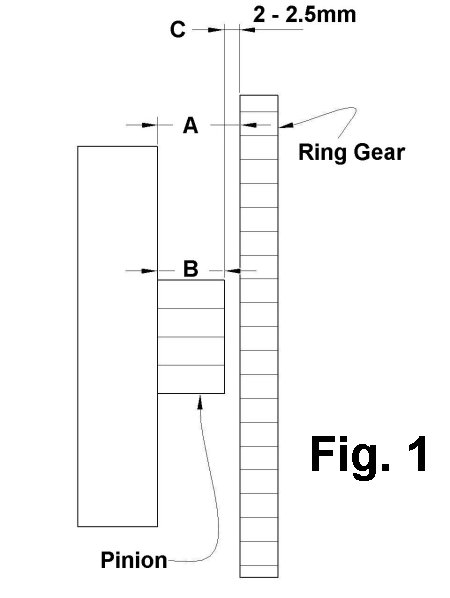 Pinion at rest measurement reference.
Spigot diameter
The spigot diameter is the diameter of the spigot that locates the starter on the bellhousing, engine, or mounting face.
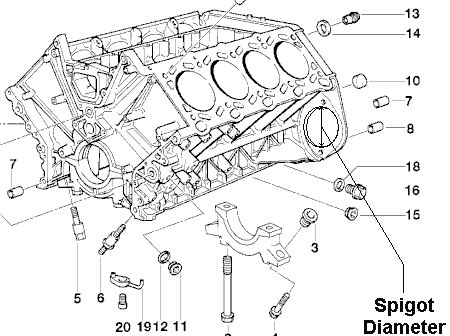 Spigot diameter measurement reference.
Operating voltage
Operating voltage is the voltage the starter is designed for. This will generally be either 12V or 24V.
Warning: using a 12V starter on a 24V system will damage the starter and void warranty. A 12V starter can run reliably using a 16V battery.
Rotating end blocks
Most Hi-Torque gear reduction starters feature rotational end blocks. This allows the starter body to be rotated to obtain the required clearance. This is done by removing the two screws that hold the aluminium block on the starter body, rotating the starter body, then replacing the screws.
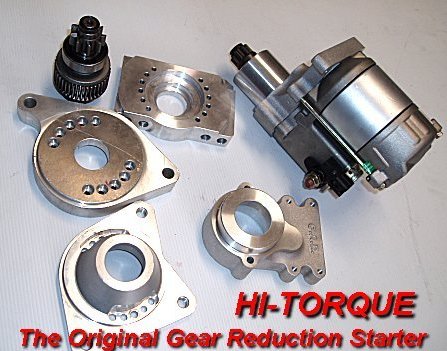 Starter body and rotating end block reference.
Starter body length guide
| Starter model Approximate body length | |
| 1.9HP starter | 165mm from mounting bolt centre or flange to back of housing |
| 2.5HP starter | 185mm from mounting bolt centre or flange to back of housing |
| 3.0HP starter | 200mm from mounting bolt centre or flange to back of housing |
The starter body length can vary by approximately plus or minus 10mm.